Millions of measurement data points support healthier indoor air in nurseries and schools in Pécs
A continuous indoor air quality monitoring system has been installed in 73 classrooms and activity rooms across six educational institutions in Pécs as part of the HungAIRy LIFE Integrated Project. The sensors record, among other parameters, carbon dioxide concentration, temperature and humidity every minute, resulting in several million measurement data points being collected during the previous school year. The results show that almost three quarters of the measurements recorded carbon dioxide concentrations below 1,200 ppm.
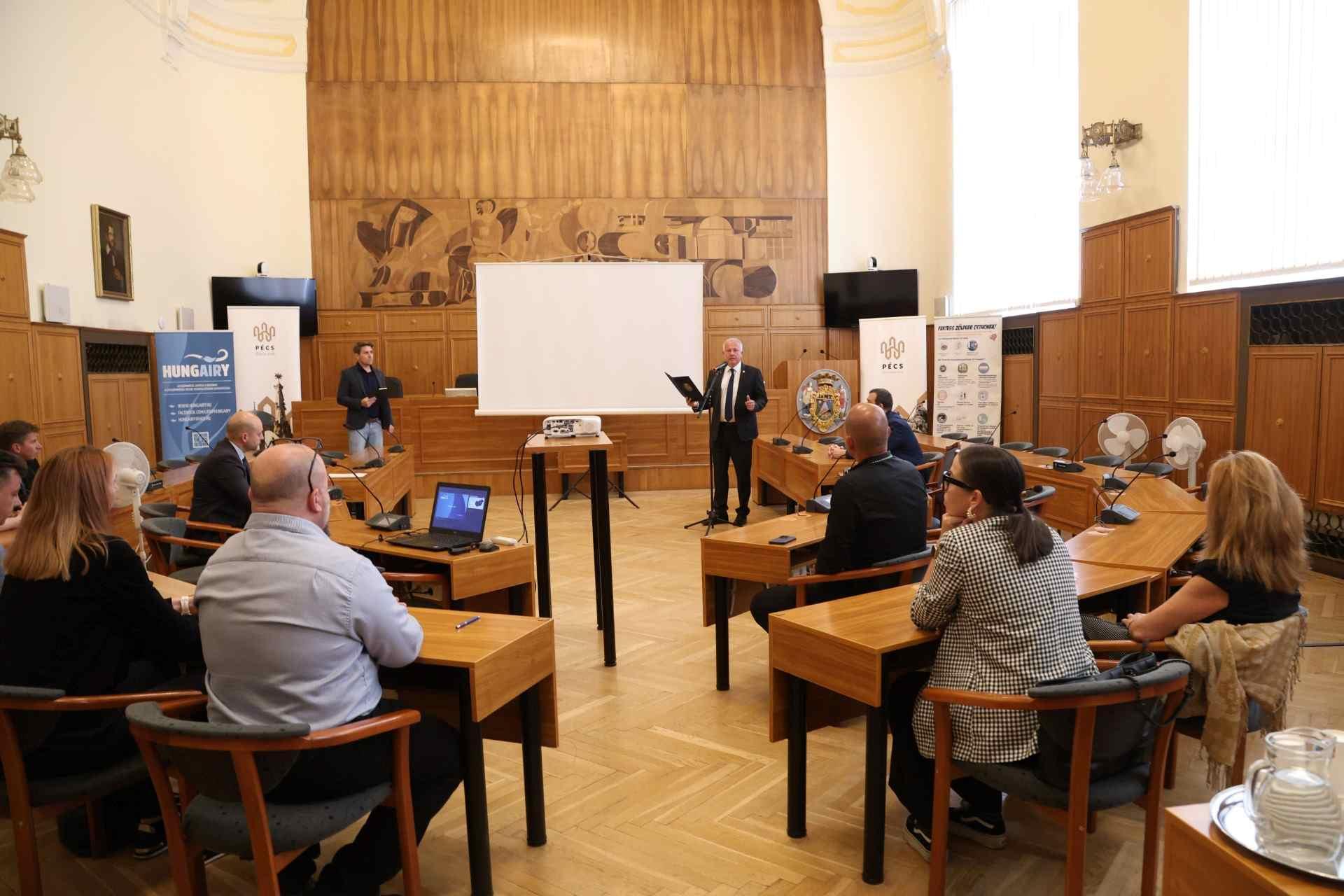
The Municipality of the City of Pécs presented the operation of the institutional air quality monitoring system implemented as part of the HungAIRy LIFE Integrated Project, as well as the experience gained from the measurements so far.
The programme involves four kindergartens and two primary schools in Pécs. The 73 indoor monitoring units measure, among other parameters, carbon dioxide concentration, temperature, humidity and the concentration of fine aerosol particles, commonly known as particulate matter. The system is also connected to outdoor monitoring units, allowing indoor and outdoor air quality to be compared.
The aim of the system is not simply to collect data, but to promote conscious ventilation practices. Continuous measurements indicate in real time when increased air exchange is needed, helping to maintain a healthier indoor environment.
What does the CO₂ level indicate?
Carbon dioxide (CO₂) is one of the most important indicators of indoor air quality: the more people there are in a room without adequate air exchange, the higher the concentration becomes.
The system uses three colours to make the readings easy to interpret: green indicates levels below 1,200 ppm, yellow indicates levels between 1,200 and 1,500 ppm, while red indicates levels above 1,500 ppm. This allows teachers to see in real time when ventilation is needed.
Millions of one-minute measurement data points
The sensors record values every minute, measuring the key characteristics of indoor air. This means that continuous data series are available rather than isolated snapshots. The data provide an accurate picture of how CO₂ levels change throughout the school day and how effective existing ventilation practices are.
“Several million measurement data points have already been collected from the 73 classrooms and activity rooms. Based on the data recorded on weekdays between 8 a.m. and 4 p.m., the average CO₂ concentration was 980 ppm, while 73.9% of the measurements remained below the health guideline value of 1,200 ppm,” said Zsolt Szabó, local manager of the HungAIRy LIFE Integrated Project.
One of the main advantages of continuous monitoring is that it clearly shows when increased ventilation is needed, thereby supporting more conscious ventilation practices.
The development is complemented by awareness-raising activities: children can also learn about the importance of indoor air quality, how the sensors work and the role of proper ventilation.
At the presentation event held on 21 September, Attila Péterffy, Mayor of the Municipality of the City of Pécs, and Dr Hunor Orbán, Deputy State Secretary for Environmental Protection at the Ministry Responsible for the Living Environment, welcomed the participants. Miklós Magay, Head of the Urban Management Department of the Municipality of the City of Pécs, presented the implementation of the HungAIRy LIFE Integrated Project in Pécs, while project manager Zsolt Szabó presented the operation of the monitoring system and the experience gained from the measurements.
Indoor air quality monitoring is part of the Pécs pilot programme of the HungAIRy project. The aim of the development is to use continuous measurement data and practical experience to support the creation of healthier, energy-efficient and consciously managed environments in educational institutions.
Related videos
Institutional air quality monitoring in Pécs – short film presenting the pilot programme
Indoor air quality – awareness-raising short film
Photos: pecsma.hu


