ATMO-Plan – Supporting informed air quality decisions
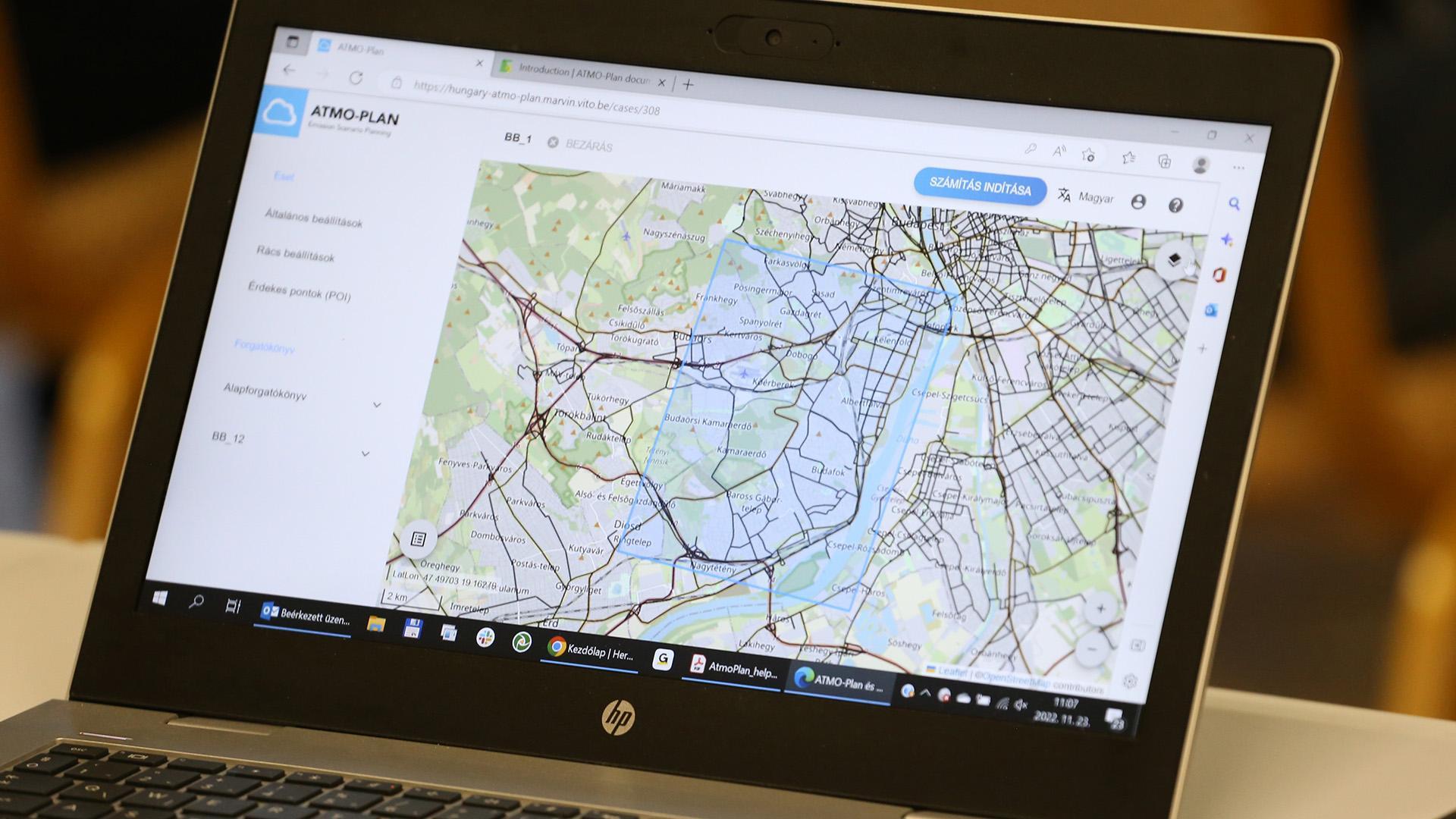
Improving air quality is a common goal for all municipalities, but selecting the right measures is far from simple. A new bypass road, changes to traffic management or the modernisation of residential heating can all contribute to reducing air pollution, but their impact may vary from one municipality to another. One of the most important achievements of the HungAIRy project is the development of a decision-support application that makes it possible to estimate the expected air quality impact of different measures in advance. This application is ATMO-Plan.
The ATMO-Plan application was developed by the Belgian research institute VITO, and its application in Hungary was adapted to local conditions as part of the HungAIRy project. HungaroMet experts also contribute to the operation of the system, the updating of background data and the provision of professional support for its use. ATMO-Plan is therefore more than just a software application: it is a modern, data-driven tool for air quality planning.
From data to decision-making
The operation of ATMO-Plan is based on high-resolution emission, meteorological and air quality data. The application combines this information to estimate how air quality in a municipality could change as a result of different measures. The system was adapted to Hungarian conditions, so its calculations take into account Hungary’s emission, air quality and meteorological conditions.
This is particularly important because the same measure does not necessarily result in the same level of improvement everywhere. In a densely built-up city centre, traffic-related interventions may be more effective, while in an area dominated by detached houses, modernising residential heating may produce greater benefits. ATMO-Plan allows municipalities to compare different options before implementing them and make more informed decisions aimed at improving air quality.
Two areas where measures can make a major difference
In Hungary, residential heating and transport are two of the most significant local sources of air pollution. ATMO-Plan was therefore primarily designed to assess the impacts of measures in these two areas.
The transport module makes it possible to model how air quality could change, for example, as a result of establishing a traffic-calmed zone, modifying traffic volumes on a road section or changing the composition of the vehicle fleet. The calculations can be used to estimate changes in the concentrations of key air pollutants, such as PM2.5 and NO₂.
The residential heating module, meanwhile, examines the potential impact of switching fuels, increasing the use of more modern heating appliances or improving the energy efficiency of buildings. These measures are particularly important during the winter period, when emissions from residential heating make a significant contribution to increased concentrations of fine aerosol particles.
A tool for the day-to-day work of municipalities
Within the HungAIRy project, ATMO-Plan was not intended for research purposes; instead, it directly supported the review of the air quality plans of the ten partner municipalities. The Eco-Managers were able to compare the expected impacts of different measures using the same methodology, resulting in a more consistent and transparent planning process.
One of the main advantages of the application is that decision-makers can rely on modelled results rather than assumptions. This is particularly important when a municipality has limited resources and needs to select the interventions that can deliver the greatest environmental and health benefits for its residents.
A legacy with long-term benefits
ATMO-Plan is one of the HungAIRy project’s achievements that will continue to provide value beyond the end of the project. Operated with the professional support of HungaroMet, the system will help municipalities prepare air quality measures using a modern, data-driven approach in the future as well.
In this way, the project has not only created a new IT tool, but has also established an approach in which reliable data, modelling and scientifically sound decision-making form the basis of air quality protection.


