Intelligent Traffic System Helps Predict Traffic Congestion in Szolnok
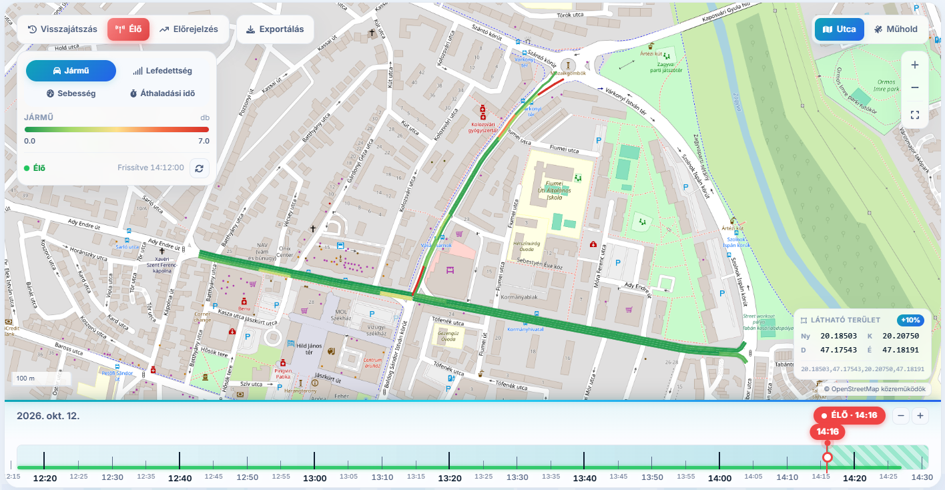
The second development phase of the Szolnok City-Eye Intelligent Transport System (ITS) was completed in October 2026 as part of the LIFE IP HungAIRy project. As part of the development, a traffic congestion detection system was installed along three interconnected road sections in the city centre. In addition to monitoring current traffic conditions, the system can also provide forecasts up to 15 minutes ahead.
The LIFE IP HungAIRy air quality protection project was launched in Hungary in 2018, with the participation of ten municipalities, including the City of Szolnok, and is coordinated by HungaroMet Hungarian Meteorological Service Nonprofit Ltd.
The first module of the Szolnok City-Eye Intelligent Transport System was commissioned in November 2022. The system collects real-time traffic data using a total of 79 sensors installed at 17 locations. Data collection is carried out using optical and infrared sensors, as well as SIM-based data connections. The measured data can be monitored in real time and retrieved in intervals as short as one minute.
During the second development phase, a traffic congestion detection system was installed along three interconnected road sections in the city centre. In addition to counting vehicles, the new system can measure average speed, travel time and vehicle density. The system analyses the affected road sections by dividing each lane into 50-metre segments, monitoring a total of 90 lane segments.
One of the key innovations of the system is that it not only provides information on current traffic conditions and data from previous periods, but can also generate forecasts up to 15 minutes ahead. This means that traffic patterns can be analysed retrospectively, while anticipated changes in traffic conditions can also be predicted.
The detailed traffic data can contribute to a better understanding of traffic conditions and provide a sound basis for traffic management decisions. In the longer term, the aim of the development is to enable the optimisation of road network capacity, traffic management arrangements and traffic light operation based on actual traffic data.
In addition to collecting traffic data, the project also involves the installation of air quality and meteorological sensors. These will make it possible to examine not only traffic volumes but also their impact on air quality, contributing to a more accurate understanding of traffic-related air pollution and providing a sound basis for more effective urban measures.
Photo: City-centre road sections covered by the traffic congestion detection system